8/28/09

SS Mystery: What does it stand for?

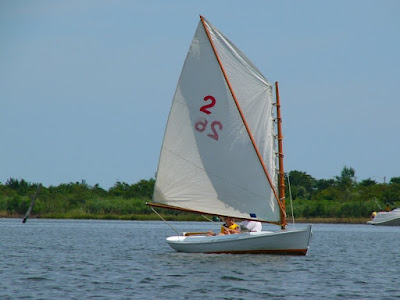
Those of you who are a part of the SS email community know that recently there was a flurry of activity discussing what exactly the SS stands for (if anything). I counted over 40 emails sent discussing this matter. It is a mystery, and certainly this post will not resolve the question. For the benefit of this blog, and those outside our community who may stumble upon it, here’s a review the discussion, and the possibilities of the abbreviation.

Seaford Skiff? Nope.

First, we can put to rest a notion that Will Tuthill had to hear from an “expert.” As Will explained, “While I had SS59 at the dock at the Museum of Yachting in Newport, R.I. some dude came up wanting to know where I got the Seaford Skiff. Ooo-kay- I had actually heard that name before, but from everything that I have ever heard it comes down to South Shore or Small Sloop. Not for this guy. He was CERTAIN. He told me in absolute terms that Seaford Skiff was what SS stood for. I'm not buying.” Soon after Will’s email, Roger Holzmacher provided clarification on Seaford Skiffs: “This is a Seaford Skiff built by Paul Ketcham of Amityville, NY. These are local to the west end of Great South Bay. I've seen a few that had "SS" on the sail but I've never heard of them refered to as anything other than "Seaford Skiff".” Thanks to Roger for providing a photo of the Seaford Skiff.

George Carmany provided further clarification. “The Seaford Skiff was indigenous to the west end of Great South Bay and beyond, and was popular at the Cedarhurst Beach Club. They would occasionally show up in small numbers at race weeks in the '50s. They were basically a 14' duck boat with a lateen rig and bore no resemblance to an SS, not even close. However, in addition to the SYC records, where they first raced in 1909, I see that Stan Medina's book on the WYS also refers to the boats as ‘Special Sloop,’ commissioned by William C. Atwater (p. 48)."

Small Sloop?

Arma "Ham" Andon, age 90, called Meredith Murray to say when he got his SS 92, which was built by Benjamin Hallock, "it was called a small sloop." That’s certainly noteworthy, given the historical significance of knowledge held by one of our elder statesmen of our SS community. Others recall a similar response from elders. Tracy Cast: “As far as my mother can remember (Karin Storer), SS always stood for Small Sloop.” Denise Dalmasse says her family also referred to it as the Small Sloop.

George Sandberg: “Small Sloop - very descriptive of exactly what the boat is.”

Small Sloop certainly seems to be the most fitting piece of the puzzle. But there are others…

South Shore?

Dean Speir: “On the other hand, the Rice family of Club Lane in Remsenburg, which had some sailing credentials, often said it was ‘South Shore.’”

George Sandberg: “
South Shore - very descriptive of the area it was / is sailed in. But not of the boat itself.”

Personally I like the nod to
South Shore as it does celebrate the area in which our magic boat fist sailed. Sailing #150 in the finger lakes, when asked about SS, I say that it is a small sloop whose specific design was the work of Benjamin Hallock in 1908, and many sailed the South Shore. But this is no proof, certainly, what SS stands for.

Special Sloop?

Doug Simes: "I recall the letters standing for 'Special Sloop' since the boat was such an early one-design concept. I'm sure it's debatable whether the SS was actually the first one-design class, but that's what I was told when I was a kid."

Shinnecock?! Really?

Meredith: "I love some of the 'I’m-absolutely-sure-it-stands-for ...XX.' My favorite is the opinion of a number of Quogue residents who think SS stands for Shinnecock Sloop. Now I ask you, would Benjamin Hallock from Center Moriches and William Atwater of the Quantuck Yacht Club (soon to be commodore of Quantuck and not long after the commodore of the Westhampton Yacht Squadron), who sent the first couple of dozen SSs to the Westhampton Yacht Squadron in Moriches Bay, name the boat 'Shinnecock Anything'??"

Rob Dudley: "Of the first nine SS boats that hit the water in the summer of 1909, five went to Quantuck and four went to Shinnecock. SS boats didn't go to Westhampton until 1914, when seven went to Westhampton and three to Quantuck. My source for this information is the QYC 75th anniversary booklet written by Gordon Dudley and Cory Reynolds."

Hmmmmmmmm. Nah, can’t be.

Slow Sinking?

Rob Dudley: “Sinking Submarine.” Rob also noted, “There is the old story of when my uncle Gordon asked Ollie Howell what SS stood for and he replied that he ‘guessed old Ben knew,’ referring to Ben Hallock who had passed away.”

Dean Speir: "Then I am compelled to note that Bobby Rice (brother of Martha and Lou) and David Royce (brother of Nancy Fenner), who are eight-nine years senior to Rob, always referred to the boats as 'Sinking Sloops' throughout the mid-to-late '50s."

Sounds like the mystery was alive and well back in the ‘50s, and those who were assigned head bailers pondered the answer.

The Alphabet / Harry S Truman

Merry: “Well, personally, after all my reading I think “SS” stands for nothing, just two letters of the alphabet like the AA class and the BB class and the B class. It was designed by all the guys who sailed the AAs and BBs, so to my mind they might have thought it appropriate to put “SS” on a small sloop. I vote for the alphabet letters SS.” Good enough for Harry S Truman, good enough for the SS.

Still a Mystery

After reading the blogs, Fred & Doris Scopinich say leave it SS. As no one knows for sure, let the mystery remain!

Bob Millstein: “Voting for something doesn't make it so. Since it is a mystery and shall probably remain a mystery I think we should leave it SS - no more and no less. SS - one of the earliest one designs in
America."

Dean Speir: "I'm on the plain 'ol "SS" side of things, and would prefer that it be said that if it actually stood for anything, that the origin of the name is lost in the mist of
Great South Bay."

I agree with you Dean, and unless the answer is found in a “beacon” of a yet to be found historical document, we will continue searching in the mist! I for one am simply happy to have the luxury and privilege of sailing one. Let the mystery endure!

8/25/09

SS Bray Prints Now Available


Kathy Bray, the noted artist whose illustrations can be seen in several seafaring books and featured in
Wooden Boat magazine, has recently added our SS class to her line of prints available for purchase. These prints are detailed and accurate depictions of some of the best-known sail and power boats ever built of wood.

Kathy's solar-powered studio is located on a Maine island, where she prints her images "off-the-grid"on 80# off-white archival cover stock with archival links, and carefully inspects each one to ensure that it matches the original rendering.

All of her images can be customized to represent your own boat. Changing colors (for sails as well as hulls), adding sail numbers and insignias, making rig alterations, and changing text for custom captions, are all part of this personalization process. You can inquire by email to let Kathy know what you have in mind, and she will gladly furnish a quote. The address is
support@brayprints.com

Be sure to check out our beloved SS featured on the Bray Prints site!
http://www.brayprints.com/prints/sloops-and-cutters/1469/ss-class/

8/24/09

Centennial Video Now Available from Don Michne


Don Writes...

"Hi Meredith, I finally have the one hour CD on the Centennial Race, July 4, 2008. Actually, its 63 minutes long including 12 or 13 minutes video taken from the air. Just prior to the race, you can watch and listen to the rules being announced. Next, the SS "parade", then clips of the races. I was rooting for Beecher in his newly made 156 and just happened to be zoomed in as he was rounding the final buoy of the final race. I watched that portion of it about a dozen times. You can judge for yourself the cause of his misfortune. Luckily, no one was hurt and there was minimum damage to his boat.

Finally, there is about 12 or 13 minutes of the many SS's in the water at one time, a sight we may never see again, taken from the air.
That part is accompanied by easy listening, background music. The price for the CD is $25. I can be reached by phone, 631-473-0080, by Email, dpmichne@optonline.net or by snail mail; Don Michne 177 Echo Ave. Miller Place, N.Y. 11764.
Just to recap;
this is not a one hour slide show. It's a never seen before, one hour movie.

8/4/09

Spinnaker Rigging

Roger Holzmacher, SS #96 & #100, is looking for someone who can e-mail him photos of a SS spinnaker pole with whatever detail there is on each end, along with any fittings for the spinnaker on the deck or on the sheets just held by hand. If any photos are sent, be sure to send them to our blogmaster so they can be posted here. Thanks!

Roger's email is holzboat@aol.com

7/31/09

The Art of Sailing


Here's some artwork recently submitted by a few of our blog followers. All are certainly beautiful. The first is a painting by Patricia Feiler. It is now hanging in the beach cottage of the Church of Atonement in Quogue. It features George Sandberg's SS.

The second and third below were sent to me from Philip Martin. Says Philip, "I came across this 1913 painting, 'Idle Sails,' by John Singer Sargent, on the jssgallery.org website. Except for the stern, the boat looks a lot like an SS. I'm throwing in Winslow Homer's 'Breezing Up,' because it exemplifies the sheer pleasure of sailing."


Thanks for the submissions!

6/16/09

George Sandberg, Teenage Boatbuilder

[Written by Meredith Murray for “The Magic Boat,” this story had to be cut in size for the final manuscript. Here is the original, expanded version.]

The Westhampton Yacht Squadron’s various club histories list all of the SSs ever built, but the whereabouts and ownership of two of these boats -- # 149 and #150 -- remained a mystery to members of the SS Association, the Great South Bay Yachting Association, and the various yacht clubs along the South Shore for almost 50 years. Until January, 2006, when a letter announcing the upcoming Centennial festivities was sent and re-sent through cyberspace to countless sailors via the modern miracle of e-mail.  Alexander “Skip” Pendzick was just beginning Center Moriches High School in 1959 when he learned that Louis Howell’s arthritis had grown so severe he couldn’t finish the two SSs he’d been building in his workshop on Lake Avenue. The numbers of the boats were already burned into the centerboard trunks -- #149, completed except for the deck, and #150, framed out with just the keel and sheer strake in place. Skip paid Howell $90 for the two boats. He kept the 149 for himself and sold the framed-out boat to his buddy George Sandberg for $40. 

The two boys had been best friends “forever,” according to George. The Sandbergs lived on Brookfield Avenue, some distance away from the water, but Skip’s family lived on Senix Creek, on the grounds of an old boatyard. “Pendzick’s Boatyard, that was my playground,” George remembers. “It wasn’t run as a boatyard then. It was just derelict.” The two boys built their first boat when they were in 6th grade, just “a little box,” says George, whose cousin Bill “Cut” Reden taught him how to sail, first in a Gil Smith cat boat and later in a Snipe Cut he borrowed from his high school English teacher, Mr. Debler.

Skip and George were only 15-years-old when they set to work on SS 149, and there was no one around to help them. “Skip’s father passed away when he was in 8th grade,” George says, “and my father had no boat experience.” Skip and his brother Dan, with some help from George, began to put the boatyard, located at 26 Union Avenue in Center Moriches, back into operation, and it was there at the reborn Pendzick’s Boatyard that they finished the 149.

“We couldn’t afford to buy sails,” says George. “Someone said the Fenners had some extra sails, so one day we walked down to Skip Fenner’s house on Union Avenue and knocked on his door and asked if he had an old sail.” Skip gave the boys a set of his old SS 2 sails that he’d been using as paint drop-cloths. SS 149 wore the “dropcloths” proudly for the next three years.

George then set to work on his own boat, the $40 #150, without any blueprints, with more curiosity and energy than experience. “What was kind of neat about putting this boat together,” he says, “was my mother would drive me to Riverhead Building Supply, and after I told them what I needed the stuff for, they basically gave it to me. They probably thought, hey, this kid is staying out of trouble! It was the only place we could get white cedar, which was basically logs, and they had to go out and mill them down.”

He worked on the 150 on and off throughout his junior and senior years in high school. “It was a chore,” he still remembers. “I struggled with it, just trial and error -- I didn’t have any plans, just a hammer. See that window? One time I threw the hammer through the window, I was so angry.

“The very last plank I couldn’t get in. I just couldn’t get it in, couldn’t make it work -- it was one plank up from the garboard plank. My cousin knew this guy named Harliss, a boatbuilder who specialized in building ice-scooters. He was a crankety old guy, not very cooperative. My cousin said if I went over there and talked to him and kind of hung around, that maybe he’d help me. So I did, I went over and I was with him from 9 in the morning until about 5 in the evening. He’d been a carpenter on a four-masted schooner, and he knew a lot about building boats. At the end of the day I finally got the nerve to say, ‘Oh by the way, I have an SS and I’m having trouble putting a plank in.’ He said, ‘I always wanted to build one -- bring it over here and I’ll fix it.’ So I went home and towed it over. The next morning I went back to ask him if he thought he could fix it, and it was all done. He’d done it overnight, and he wouldn’t tell me how he did it. I’d been working on it for months, trying to figure out how to get that plank in, and he did it overnight.”

George finished SS 150 during his senior year, and with great pride he berthed it alongside SS 149 at Pendzick’s. Not long afterwards, however, he and Skip narrowly escaped disaster in the 150. “We’d finished the boat,” George explained, “and I was out sailing with Skip. Around 10 or 11 o’clock at night we were becalmed. It was absolutely pitch black, and we heard a boat engine. And it was coming closer and closer. We didn’t have a flashlight, nothing. That boat came within inches of us, at full speed. I thought we were done for. As it passed we heard someone say, ‘Hey! There’s a boat!’”

Neither Skip nor George ever raced his SS, and neither one ever made any contact with the yacht clubs. “I liked everything about the water, and sailing was a part of it. The racing part never appealed to me,” says George. Instead he just sailed -- to the head of Senix Creek, out into Moriches Bay, exploring east and west. Half the time he sailed by himself, and half the time he took someone with him. Or the two SSs would sail together. “Skip would be in one boat, and I’d be in the other boat. One time we decided to see how far west we could go. We sailed to Great South Bay, way past the Smith Point Bridge -- I don’t know where we were. Skip’s brother was trailing behind us in an outboard, and we put up a little tent and slept on the beach.” When asked what they’d brought to eat, George answered, “Eat?? I think we just drank beer!”

The boys sailed over to the town beach at Great Gun, went for clams and crabs with their boats, and used one or the other of the SSs for camping trips. “We used to do a lot of camping,” George says. “We slept on the boat, one of us on either side of the centerboard. It was a perfect fit.”


Skip had the 149 until the early 1970s, when he sold it. George sailed the 150 until 1966 or 1967, when, he says, he “went to sea for a living,” beginning with service in the Merchant Marines, distributing supplies along the coast of Viet Nam.

SS 150 was still very much a part of George’s life in 1969 when he was courting his future wife Joy, who was not a sailor. He took her out in the SS to, Joy says, “drown me...in a hurricane.” Not so, says George. “It was just a squall. It was really blowing, and we flipped. I didn’t want anyone to know it happened because I was embarrassed, so I made her sit in the sun until she dried out.” However, George’s buddy Stan Abrahamsen had seen the SS capsize. “By the time we got back to town, everybody knew.” But, says Joy, “I married him anyway.”

Like George, Skip Pendzick, too, graduated from the New York Maritime College, as a Marine Engineer. After sailing for a few years, he earned a Masters Degree in Nuclear Engineering and went to work for Brookhaven Lab, where he currently is the Chief Engineer for the Accelerator. He and his younger brother still own and run Pendzick’s Boat Yard.

He never named the 150. “If I named it now,” he said, “I think I’d name it something like ‘Lost.’” Looking askance at the boat Joy mutters, “’Derelict.’” 

Six months later George wrote that he had “cleaned up” #150 and had put it under cover in a shed. But, he admitted, although things didn’t “look good for it,” he hadn’t given up yet. Not long afterwards he e-mailed triumphantly that he had bought his neighbor Ray Richmond’s SS 76 and was “getting ready for the Centennial!”

SS 150 may not make it to the yacht club for the 100th birthday celebration, but, with # 149, it is now safely logged into the official chronicle of SSs “that really were.”

And, “one way or the other,” Sandberg will be sailing an SS in the Centennial parade.

Today George Sandberg is a Captain in the United States Maritime Service. In 1990, after sailing for 20 years with the Merchant Marines and wearing ribbons awarded him by the U.S. Coast Guard, the U.S. Navy and the Merchant Marine, he “swallowed the anchor” and came ashore to teach at the Merchant Marine Academy at King’s Point, where he is currently the head of the Marine Transportation Department. 

Both George and Skip still hold the SS close to their heart. As George says, “I have sailed around the world a few times, sailed on every ocean and on most seas, aboard many different types of ships ranging from a 65-ft. research vessel to a 1,000-ft. LNG vessel, but some of my best memories are sailing an SS on Moriches Bay.”

SS 150 still survives but only barely, as it has been sitting uncovered in George’s backyard for the last 30 years. “It came real close to being sawed up and used for firewood last year,” said George as he and Joy stood on their lawn, looking solemnly down at the rotting hulk of a boat. “But I decided I’d try to fix it up. I think I can salvage it with stitch and glue. I have some other ideas. I have a complete set of ribs in the basement.” A few seconds went by before he added, “Joy isn’t too enthralled with the idea of my restoring my SS.”

But George’s imagination is captivated by the idea of sailing an SS in the 2008 Centennial celebration festivities. “One way or the other,” he says, “Sandberg is going to have an SS!”
   
EPILOGUE: George did indeed sail an SS in the Centennial parade, but it was not SS 150. Instead, George sailed #76, a boat he purchased from his Center Moriches neighbor, Ray Richmond. The “derelict” “flower pot” SS 150 George gave to Fred Scopinich in partial payment for the restoration of his “new” SS 76, which sailed in the parade as “The Spirit of ’76.” Fred miraculously brought SS 150 back to life, sold it to Paul Haines, and that boat, too, sailed in the Centennial parade. Paul named the boat “The Two Sisters” and registered it for the parade under the name of his two granddaughters Noel and Naomi Haines, who served as crew with Cheryl Baker and Sue Jenkins skippering.

After the Centennial, SS 150, once just a dream in the eye of an Center Moriches teenager, was trailered to up-state New York, where, renamed “Endurance,” it now resides with Paul’s son Will Haines, the author of this blog, who sails it on the waters of Keuka Lake every summer. From Center Moriches to the Finger Lakes, the fame of the SS continues to spread!

6/11/09

Chit-Chat: In the Lead?

Can anybody identify the people or boat in this photo, or the year or even the decade? The only identification on the back of the photo in the Westhampton Beach Historical Society's collection is:

"In The Lead, catboat racing, Wm H. Winters Real Estate & Insurance Book. "

Meaning it was from a calendar of old photos put out by Bill Winters sometime back when. The boat is flying a Shinnecock Yacht Club flag.

My only guess, time-wise, is that the crew and the photo look somewhat like the same
vintage as photos from the very early 1900s.

Any thoughts? - Merry

Note: you can click on photo for a larger view.

6/6/09

"The Days, Rices, Bakers and the SS, An Unfinished Piece" by Louise Rice Baker

A gift of gold, sent by Marty Baker to Meredith Murray on June 5, 2009, and written by his wife Lou, who passed away just two months ago. Marty writes:

“I am sending you a copy of the information Lou had started for your great book and never got finished before publication. If you have a sequel, (I'm sure there has been a cry for it), maybe it will add a little more data and history of the great class of boats. If not it will add a bit of info to your collection. Anyhow, she was sorry she procrastinated and didn't get this to you before your deadline. She worked on it
thru the end of last year before she got this much done. You have my permission to use as much or little as you see fit either in publication or sending it to those in the SS group that might enjoy it.  Thanks, Marty”

Because I procrastinated and
didn’t get the Days and descendants adventures with the wonderful little 16' gaff rigged wooden boat designed for the shallow bays of the south shore of Long Island I will now commit them to paper albeit late.

I don’t know the year but in the 1920's Newton and Louisa Day gave their 4 children SS 57.  She was named Pickle (a name I never liked) because of Heinz 57 Varieties of Pickles.  The boat was originally for the 2 older boys Newton and Bob.  I’m sure they were thrilled, but when they
didn’t do well in the races and mildly (in those days you didn’t complain about a gift from your parents) suggested the fault was in the boat.  My grandfather declared that he and my grandmother would race next Saturday.  They were renting (as they did for many years) a cottage at Jaggers or Cedar Beach, known for many years after as the “Day Cottage”.  My grandfather who worked a half day on Saturdays came out on the train rushed to the dock at Jaggers where my grandmother was waiting.  They won the race handily, sailed back to the dock and the boys were greeted with “There’s nothing wrong with the boat”.

On the other side of the family my uncle Charlie Rice won the very first Smith’s Point Race.  I regret I know nothing about that race or how he happened to be sailing an SS.

For several years the Day boys did much better in 57 and when my mother Sis Rice and her twin brother Tom Day were old enough they took over.  My mom told the story about being incensed when the newspaper reported that the 3 Day boys won a race in
Bellport when she was the one who bailed the boat around the course.  Imagine calling her a boy!!

Later probably in the early 30's Tom Day and his buddy
Erben Jenkins sailed 57 around L.I.  Their story was about taking a slip in Montauk Harbor next to a pristine yacht many times larger than their SS.  They were not appreciated when the can of baked beans they were heating on a sterno stove blew baked beans all over the yacht.  They didn’t know you should open the can first.  The uniformed crew on the yacht hustled to clean up the mess as they glared at the boys.

The 38 hurricane put SS 57 in a tree, but she
wasn’t damaged very much.  When my family began to summer in the Rice summer home in Remsenburg in 1940 she was refurbished and was sailed by the 3 (Martha, Louise and Bobby) Rice kids over the next several years.

During the war the races were held off the
Apaucuck Point House.  My parents raced an old catboat they had acquired and restored after the hurricane.  Sometime during that time my older sister Martha sailed and raced 57.  Then it became my turn and about the age of 9 or 10 I had my dreamboat.  As soon as we could prove our sailing and swimming abilities my cousin Snowdie (Brinkley B. Snowden, Jr.) and I spent many hours on the bay.  He sailed his family’s SS10 and I sailed 57.   These two little boats became pirate ships, exploration boats and Starboats the ultimate racing machine of the day.

Snowdie and I did something at about the ages of 12 and 13 in our SS’s that wouldn’t be possible today and most parents would not permit.  However, our parents gave us permission to sail our two boats from Remsenburg to Southampton.  We were to sail to their old friend’s house on the same creek the SHYC is on, spend the night and sailed back the next day.  In those days you were allowed to sail through the bridges without a motor.  We did it.  I remember struggling through the bridge fenders against the current on the way there and sleeping on the floor in her house but not many other details.  We were thrilled to death to accomplish it.

Those summers were filled with Ladies, Junior and Saturday races with much serious training by my mother.  “Watch your sail, stop sawing the tiller, look at your wake, why
aren’t you watching your sail!”  I loved every minute of it except maybe the cold, wet beat that seemed endless sometimes as you hung out as far as you could.  Then there was always the Midget Championships and that’s when the Fenner boys came into my life–mainly Pete and Skip.

When I was about 13 a bunch of us
Remsenburg kids and our SS’s started gathering almost every weekday to have impromptu races, sail to the beach, play tennis ball tag with our boats and when the day came to an end play croquet or cards at someone’s house.  Rice SS57, Fenners SS13, Snowden SS10, Royce SS101, Seibert SS68.  We called ourselves the Remsenburg YC and raced off a dock near the Fenner’s house.  When regular racing became boring we held races where you could not touch the tiller between leaving and returning to the dock.  All steering had to be accomplished with sail trim and weight.  So we would sail a standard triangle course and land at the dock without touching the tiller.  It improved our sailing skills and showed what a wonderfully balanced and designed boat the SS is.  One of our most memorable activities was the beach party–we would sail to the Royces’s Bunny Hutch beach house.  Swimming, baseball, hotdogs, hamburgers, corn on the cob, watermelon, toasted marshmallows and singing around the fire all ensued.  What memories of the stars, the ocean murmurs and then the sail home in our SS’s.

About this time my brother Bob was getting into racing.  I was assigned to crew for him in the Friday Junior Races.  We sailed the first round without incident but as we approached the leeward mark (in those days the pin end of the starting line) I hurriedly took the spinnaker down and threw the pole under the foredeck.  Unknowingly I hit Bobby in the head with the end of the pole and was very surprised when he hit me over the head with the centerboard stick. Meanwhile the Race Committee nearly fell overboard laughing.

When I was about 14
WYS and Shinnecock YC had pretty good Lightning fleets.  As remember it they decided to have a race on a Sunday afternoon and the SS fleet decided join in the fun.  For some reason Pete Fenner didn’t have SS 13 and so he crewed for me.  The Lightnings started first on a reach headed for Seatuck Cove with the SS’s on the next gun.  For a few minutes Pete and I were busy with the start and maneuvering for clear air.  When we looked ahead into the gray, foggy looking cove we were wondering what those strange things in the water were.  As we got closer we realized they were Lightning bottoms.  A squall had hit and dumped the whole fleet except my parents and a Shinnecock boat.  The wind picked up as we approached the cove and as soon as we passed the mark we anchored and let the sails down.  We scrambled under the sail because the rain was so hard it hurt.  A couple of other SS’s did the same thing but as I remember it most of them turned over too.  When the squall eased up we hoisted sail and anchor and went on to win the race following the two remaining Lightnings.  Pete and I had a great time.

During those tween and teen years our lives were pretty wrapped up in the SS and the
WYS. We were racing in the Jr., Ladies, July, August Series as well as the Smith’s Point Race, Cruise Week, Bellport Labor Day Series and the SS Association Races.  Most of us at least second generation sailors.  The skill and seamanship was at a fairly high level as demonstrated by how our little club did in the Midget, Jr., Ladies and Men’s Great South Bay Championships over the years.  Several of us were also involved in teaching and running the sailing program at WYS.

Not too many years later these same teenagers were getting their own kids started in our great little boat and the 3rd generation took over.  
Although it was difficult for us old folks to give her up and many of us raced on into adulthood.

One of my first races with my (then) non-sailing husband took place at
Quantuck in an Association race.  It seemed like that tiny bay was wall to wall SS’s.  It was 3 times around which didn’t help the crowdedness.  It was light air, we got a not very good start, but managed to be near the front of the fleet at the windward mark.  Poor Marty struggled with the unfamiliar spinnaker for almost the entire run and by the leeward mark it seemed everyone had gone by.  We fought our way back up to the front only to have the same thing happen again.  At this point we were literally snarling at each other.  Finally on the last lap the jib eyebolt pulled out of the foredeck and we could respectably retire.  Then we laughed and Marty says that anything said during a sailboat race cannot be held against you in divorce court.

My kids feel as attached to the SS as I do.  When they started getting good and 57 was getting very tired we bought SS 148 from Kit and Cliff Cramp.  Bud
Simes let us unofficially call her 157 and they spent many years sailing and racing her.  Their attachment may be different–times had changed but the specialness of that little boat–the freedom, responsibility, freedom of imagination (my SS was a pirate ship, a Starboat, etc.), that she gave us all is irreplaceable.

A word about the design of the SS.  In our family her ability and gracefulness in the south shore bays was much admired.  The
skeg and inboard rudder did not pick up seaweed (a real problem in her earlier years before the inlet) not to mention the very important ability to sail in very shallow water with the board up and a rudder still functional.  Today’s design leaves you with no board and no rudder and actually no way to “sail”.  She was a small version of the boats of her day and a wonderful design.  The pureness of her lines was proven when Bayard Fenner and Bob Mattison began to make a fiberglass version–the Cottontail.  Of course they put a Marconi rig on her and deepened her freeboard but basically she was the same hull. She was so fast that that little 16 footer was always sailing in the “big boat” fleet during cruise week and Bellport.  Unfortunately, she never caught on and I am not sure if any are still around.

Rest assured Lou, the SS fleet sails on.  Thank you, Marty,  for sharing this wonderful narrative with the SS community.

6/1/09

First Sail on the Spindrift

We had our first sail in the newly restored SS 101 [SS ?-3] today, May 30th, 2009. It is a very beautiful boat. So! What’s it like to sail an SS for the first time in 50 years, when the once 15-year-old sailor is now a card-carrying Medicare recipient?

The boat is smaller than it used to be, I swear it is.

Standing on the bow seemed tippier than in yesteryears. And more slippery.

The boom seems much lower than when we were kids, but of course it isn’t.

The new Dacron sails are stiff and noisy and unromantic. Crackle, crackle.

We still had to bail the boat out despite the beautiful new sail cover because we had torrential rains yesterday.

The fancy sliding jib pull takes up 6” on the deck, just where I want to plant a grandchild.

The fancy mainsail winch, which is ever so easy to operate, is located on the aft part of the centerboard and we’re so big now that between the over-sized winch and the tiller there’s barely room for the skipper and not enough room for bailing, at least not with my 1944 hand-carved scoop….and, indeed, being an SS, there is still a lot of bailing to be done, just like 50 years ago.

The strong wind which I blithely called “whussy wind” was too much for the whussy senior citizens. Because as soon as we tucked in for a scrappy fast sail, the first wave came over the bow and hit me. WOW!! Was it ever COLD COLD COLD!! Now, I expected to be wet…but I never imagined that a bow wave in May felt positively Arctic.

It was a short sail. I sit here at my desk, staring out the window at the benign-looking little sailboat. How hard could it be to sail that silly little boat??

I kept thinking about the grandchildren and the fun they’re going to have learning to sail. Okay, we take away the sliding pulley and make room for their little tushes. We go out when the wind is calmer. In July when the water is warmer. Okay, this can work, they’ll love it. And then I saw the pink jellyfish. IN MAY!! What the !@#$% were JELLYFISH doing in Beaver Dam Cove in frigid bay water??

End of first report.

5/26/09

A Boy's First Sail

It is a moment in time that all of us, if we were old enough, clearly recall.  This past weekend, I had the opportunity to take my four-year-old nephew, Nicholas, on his first sailing excursion.  As a dutiful Uncle, you want your nieces’ and nephew’s first experience on a sailing vessel to go smoothly.  You don’t want a sudden gale to hit, nor do you want to wallow in the middle of the lake in a dead calm.  Basically you don’t want to be the guy to cause trauma in the minds of the youngsters that you have been entrusted to care for. So with clear skies, a steady breeze from the North, and no ill weather on the radar, we set out!

It’s wonderful to experience the questions you get from a young lad who is sailing for the first time.
 The quietness of the sail as we started out prompts the first query.

“Uncle Willy, where’s the motor?”

I chuckle.
  “Well, it’s up there in the sails – the wind pushes the boat.”

“Oh.” I can see his mind working.
 Pause. Next question…

“How are we going to get back?”

“Well, we’ll just turn the boat around and make it go where we want to go.”

“Oh.”
  Pause.

“Uncle Willy, are you too heavy for this boat?”
  Another chuckle, and certainly a legitimate question.  Kids don’t pull any punches, do they?

“Oh, no – we’re fine, this sailboat can handle plenty of weight.”

“Okay – hey, we’re moving fast!”
  And we’re going at a relatively good clip.  Just enough wind for a good ride.  After getting three-quarters across the lake I announce it is time to "come about."

“Uncle Willy, what’s that?”

“It’s when we turn the boat around and head in the opposite direction.”

“Are we going to head there?"
  He turns and points upwind to the other shore.

“Yes.
  Okay duck your head a little and get ready to come about.”  Not that he needed to, sitting in the front alongside the centerboard trunk he has plenty of headroom between himself and the boom.  Ah, to have that luxury once again.

We tack up a few times about half a mile upwind.
  I can see he’s feeling at ease with this whole sailing thing.  Time to put the lad to work.

“Nicholas – would you like to bail some water out of the boat?”

“Okay, Uncle Willy, I can do that.”

“Thanks, Bud.”

I hand him the plastic bailer.
  He makes fine work of the task.  A few minutes go by.

“Uncle Willy, can I stop bailing now?”

“Of course.
  Thanks Nick, you did a great job.”

And he did – there was no water left in the boat.
  We sailed a little longer.  Fifteen minutes later I figured I should get the lad home, so we turned about and headed downwind.

“Hey Nick, do you want to steer the sailboat?”

“Yes!!”

I get Nick situated on the other side of the tiller to where I am sitting.
  With both our hands on the tiller, we look homeward.  He’s smiling.  So am I.

And so Nicholas joins a fortunate group of people who have sailed this magic boat.

5/25/09

Another newly-found SS returns to the line-up: “SS 101” Spindrift

SS ?-3 was launched today by new owners Bob and Meredith Murray. With the approval of the SS Association, the boat has been given the number SS 101, after a long-gone sailboat that was chopped up and taken to the dump many years ago. The “new” SS 101 now resides in Beaver Dam Cove, Westhampton, in front of the Murrays’ house on Apaucuck Point. Named “Spindrift” after Meredith’s grandfather’s yacht, the SS proudly wears atop its mast the tell-tale wind indicator that once adorned another of Meredith’s family’s SSs, #84 Mariposa, when that SS lived at Apaucuck Point in the 1940s-1970s. Danny Kammerer, the present owner of #84, presented Meredith with the tell-tale at the July 4, 2008 Centennial celebration. The boat has been meticulously restored by Fred Scopinich. 

Meredith’s and Bob’s plans for the boat are slightly different. To Meredith, SS 101 will serve as a vehicle for teaching all members of the family, children as well as adults, how to sail, and she envisions hours of happy, stress-free sailing at all times of the day plus on moonlit nights. Bob and Fred Scopinich, however, seem to have equipped SS 101 in such a way that it looks suspiciously like a racing machine.

Either way, another SS has been saved!!

HISTORY OF THE BOAT AS WE KNOW IT:
Dick Scopinich found the boat discarded in Chesterfield Associates’ scrap yard in Westhampton sometime in 2006 and considered it to be unrepairable. The transom was out, the skeg was torn off, and the boat was held together by a medium-blue fiberglass hull covering. Dick brought the SS to his brother Fred at Fred’s Hamptons Shipyards “just in case” the boat was salvageable. The mast, boom and sails were missing, and no identification number could be found anywhere on the hull.

According to Fred Scopinich, the SS was built by Ben Hallock, as confirmed by the centerboard trunk construction and the mast step and by the fact that the boat had butt blocks on its planking which later builders (after 103) didn’t use. But, according to Fred, “this boat was fiberglassed and the deck was not typical Ben Hallock construction, that is, 5/8” x 1-3/4” cedar. This boat has an extra strong deck of ¾” x 2 ¼” wide vertical grain cedar, leading me to assume the deck was replaced at some point. This deck that was sound was the reason why I decided to save the boat.” 

The newly designated “SS ?-3/SS 101” is now fully restored with a new stempost, new keel, and new transom. It also has all new hull frames re-fastened at all planks; an all-new centerboard trunk; a new rudder assembly; and the hull has been covered with 2 layers of West System epoxy resin and cloth. The sails were made by UK Sailmakers of Bronx, New York http://www.ukhalsey.com/ and include a mainsail of 4.9 oz Dacron, Jib of 4.9 oz Dacron and a lightweight spinnaker.

Because Fred Scopinich has had occasion to sail in several boats that he has recently restored, he has incorporated a few updates into the restoration to better enable the Senior Citizens-pretending-to-be-children-again to sail the 16 ½’ boat. These include color-coordinated halyard lines so that age-weakened eyes can distinguish the jib halyard from the spinnaker halyard; a window in the sail to prevent some whippersnapper from ramming the newly restored sailboat; an extension-bar on the tiller; easy-hold mainsheet winches for arthritic hands; and, upon request, padded kneeling cushions (one on either side of the centerboard) for ancient crew members.

5/22/09

Jim McDermott’s First Love

Here's another story that didn't make The Magic Boat final cut, at least in it's original expansive form. Thanks to Jim for the permission to post this delightful story.

“I was seven years old and had stolen away from Quantuck Beach across Dune Road to gaze covetously at the SSs tied up at the Beach Club’s dock.  As usual, several were tugging at their painters in a soft southwesterly breeze.  I sat on a piling woolgathering, drinking in their gleaming varnished decks and spars and their trim white hulls.  I was startled out of my reverie by an approaching SS.  It was Cory Reynolds, one of the ‘big kids,’ artfully tacking an SS up to the western side of the dock.  When he was twenty yards distant, he pointed her bow directly into the wind and dropped the mainsail neatly into the cockpit.  As the he coasted in, the jib gently luffing, he pranced up to the bow, picked up the painter and stepped onto the dock just as the little boat lost way.  He snapped the painter around a piling in a quick half hitch, grinned at me and said, ‘Hey, kid,’ and walked toward the beach without looking back.  I was transfixed.  ‘One day,’ I murmured, ‘I will have an SS of my own.’

 “I regularly petitioned my family for one even though I knew the inevitable answer: ‘Maybe one day when you’re a lot older.’  Occasionally, Cory or Bill O’Brien would take pity on me and take me out, even let me take the tiller for a (very!) short time, but I was a little kid, and they would lose big kid status if I remained on board for any significant length of time.  Two years later, my father bought a newspaper in Madison, New Jersey, and our family didn’t return to SS territory till I was 19.  Curiously enough, I happened into Nickerson’s Boatyard in East Moriches the summer of ‘62 to see two of the last SSs, 152 and 153, being built.  The old pang returned, but I was into fast boats, waterskiing and girls. I did crew on Standish Medina’s MB, Ethel, and Jeremy Medina and I took the occasional picnic cruise on her with dates, but then the Army called as did the need to make a living.  When I got out of the Army and was ensconced in a job,  Bill O’Brien and Barney Edwards scoffed at my SS pipe dream and talked me into racing Sunfishes in the fledgling Aspatuck Yacht Club.

“But old dreams die hard.  In the summer of ’76, just when my new bride, Judy, and I built a summer house in Quiogue, I heard that Jay Dudley had restored SS 128 and had decided to sell it. She had had fine racing provenance, having been campaigned to championship seasons by George Carmany at the Westhampton Yacht Squadron in 1956 and thereafter by Bob Murray at the Shinnecock Yacht Club.  Adding to her charm was the fact that she was built in 1939, the same year I was.  While Judy and I had no intention of racing her, I bought her on the spot, and we were sailing her as soon as Jay’s final coat of bottom paint had dried the next week.   

“Emily Graves Jones let us keep her in a slip adjacent to her property on Quiogue’s Delafield Point.  Judy and I regularly commuted to Quantuck Beach Club from Emily’s dock space in Quiogue each summer weekend day.  Our first such sail was on a fair, late-June Saturday in a light southwesterly.  I tacked to the western side of the Beach Club’s dock and, about twenty yards out, pointed directly into the wind, dropped the main, pranced past the luffing jib, picked up the painter and jumped on the dock just as our little boat lost way.  I snapped a half hitch around the piling and grinned at Judy.  ‘That was pretty neat,’ she said.  ‘Where’d you pick that little trick up?’

“’Right here about thirty years ago.’  I answered in my best Cory Reynolds offhand manner.  

“Each fall we would delay hauling SS 128, which we named Random since so many of our sails had no particular purpose or destination other than to be out on Quantuck Bay’s halcyon waters.  In our second season, we enjoyed a string of beautiful October weekends and decided to keep Random in till the weather turned.  On the first weekend in November it did, with a vengeance.  That Saturday morning it was gusting well above forty miles per hour out of the Northeast in a light, but stinging, rain.  We had to sail from the west side of Delafield Point to the takeout point at the end of Sheppard Street on the point’s east side.  I feared for Random’s rigging in the stiff northeaster.

“We tried sailing her with just the main, but she wouldn’t point, so we tried with just the jib, but she jerked and yawed around uncontrollably.  So we set both sails, set her into a broad reach and gritted our teeth.  We nearly capsized in the first gust, but let both sheets way out as the sails flailed furiously, then gingerly began to haul them in.  The mast groaned against the stress and the deck crackled as the little boat gained way, her every fiber—and ours!—strained to the breaking point.  Then she bobbed up on a plane.  The little boat surged forward like a puppy let off his leash, and suddenly we were flying.  The halyards thrummed and hissed.  I glanced astern and we were throwing up a rooster tail three feet high and fifteen feet long.  The tiller felt alive in my hands -- remarkably tender, yet scarily responsive.  Although the whitecaps were deeply troughed, the little sloop skimmed smoothly over them.  SSs are renowned as ‘wet’ boats, but Random was flying too high and too fast to take on water other than the rain.  It felt as if the little sloop had been created to be on that broad reach in that November northeaster.  We were at the south end of Quantuck Bay in what seemed like seconds, came about and screamed back to our starting point, making pretty near forty knots.  

“We tacked to and fro for an exhilarating hour, then, chilled to the bone and adrenaline-depleted, decided to head around Delafield Point to the trailer we’d left at Sheppard Street.  To this point we had avoided jibing, but this destination would involve a jibe, which terrified me.  So instead, we tacked a 270 degree partial circle, perhaps the smartest, if decidedly unseamanlike, move I have ever made on a boat.  I have never gone faster in a sailboat before or since, though we did get Random up on the plane in fall blows several more times thereafter.”

Judy and Jim continued sailing their SS every weekend, “commuting” from Quiogue to the Quantuck Beach Club -- “usually a lovely reach each way because of the prevailing southwesterlies,” Jim remembers.

In 1980 they moved to Quogue, where they moored their SS at the Shinnecock Yacht Club for three seasons, but the little sloop proved too small to accommodate their growing family.  Shortly after the birth of their son David, Jim sold Random for a down payment on a 19-ft. Cape Dory Typhoon sloop. 

For some years afterwards sailing continued to play a large role in the lives of the McDermott family. In time golfing’s Siren call lured Jim to the golf course, but memories of his SS days -- of a 7-year-old boy coveting the trim sloops tied to Quantuck Beach Club’s dock, of planing Random across the bay in a terrifying yet exhilarating nor’easter -- refuse to fade away.